I Took This Photograph Back to Chios

Updated: Jul 25
In 2026, 36 of these photographs returned to Chios for a museum exhibition. Watch the new film from Chios or explore the available fine-art prints from the island.
In 2021, I photographed a woman wearing the traditional costume of Pyrgi against one of the village’s geometric walls.
Five years later, I returned to exactly the same place.

This time, I was not there to make the photograph again. I had brought it back to Chios as a finished, framed work, together with 35 other photographs from the island, for the opening of my exhibition Caryatis Delta | Chios at the Chios Mastic Museum.
The journey became the subject of my latest film: I Took This Photograph Back to a Greek Island.
But the film is not simply a record of an exhibition opening. It is about the moment when a photograph leaves the screen, gains a physical presence and begins to exist somewhere beyond its photographer.
When does an image become a photograph?
A photograph can spend years living on a screen.
There, it has no fixed size. I can enlarge it, reduce it, edit it, move it into another folder or forget about it entirely. It remains flexible and protected. Nothing has been permanently decided.
I have never felt that this is the final state of a photograph.
For me, the image changes when it becomes physical. It acquires paper, scale, texture, weight and edges. Once it is framed and placed in a room, it must form a relationship with architecture, light, neighbouring images and the people who pass in front of it.

A screen allows an image to exist almost anywhere.
A print has to exist somewhere.
That difference is at the centre of the film and of the exhibition.
Returning to the wall in Pyrgi

The photograph used for the exhibition invitation was made in Pyrgi in 2021.
We selected it partly because the geometric surface is immediately characteristic of the village, and partly because the Chios Mastic Museum itself is located near Pyrgi. The image created a direct connection between the subject of the exhibition and the place that would eventually receive it.
Pyrgi can be deceptively easy to photograph. Its decorated façades are so visually forceful that they can overwhelm the person standing in front of them.
When I created the photograph, I did not want the wall to function as decorative scenery. The woman, her costume and the architecture needed to occupy the image together.
In the film, I stand in approximately the same place myself. The comparison is slightly ridiculous, but also revealing. The original photograph works because the woman does not look as though she has been placed in front of an interesting background. She appears to belong within the visual pressure of the wall.
Five years later, the question was whether the photograph could carry that relationship from Pyrgi into a museum.
Caryatis Delta | Chios at the Chios Mastic Museum
Caryatis Delta | Chios opened in July 2026 at the Chios Mastic Museum under the organisation of the Piraeus Bank Group Cultural Foundation.
The main exhibition contains 36 black-and-white photographs made in Chios, depicting women of different generations in the island’s villages, buildings and landscapes. The work encompasses local costumes and variations documented across 21 villages of Chios.
The museum is situated within the Mastichochoria of southern Chios and is dedicated to the cultivation, processing and cultural history of mastic. Its location makes it more than a neutral exhibition venue: the museum is part of the same cultural landscape from which many of the photographs emerged.
The 36 Chios works consist of:
33 photographs presented at 80 × 60 cm
three numbered works presented at 140 × 110 cm
A distinct final section contains three further numbered works from Evros at 140 × 110 cm. These connect the Chios exhibition with Caryatis Gamma | Thrace, previously presented at the Silk Museum in Soufli. That earlier exhibition brought the project into another PIOP museum whose subject—silk—was directly connected to the materials and identity of the local costumes.
The result is therefore not simply a selection of photographs from two regions. It is part of a developing exhibition sequence in which each body of work enters a museum connected to the material culture of the place.
From digital files to exhibition prints
All the works were printed and framed in Athens by Sdralis Fine Art Printing, under my supervision.
The photographs were produced on Hahnemühle Photo Rag Baryta 315 gsm using Canon LUCIA pigment inks.

The 80 × 60 cm works were placed in solid black oak frames with mats. The larger, numbered 140 × 110 cm photographs were presented in solid pine box frames.
These decisions are not separate from the photographs.
Paper affects the density of the blacks, the behaviour of the highlights and the physical character of the image. Scale alters the way the viewer encounters a person. Framing determines whether the photograph appears contained, distant, architectural or almost object-like.
This is why I treat exhibition production as part of the artistic process rather than as a technical task that begins after the work has been completed.
The same approach forms the basis of my museum-quality exhibition printing and framing service, created with Sdralis for artists, galleries, museums and institutions producing exhibitions in Greece and elsewhere in Europe.
The exhibition begins again inside the room

An exhibition can appear completely resolved on paper.
There is a title, a list of works, a floor plan, dimensions and carefully prepared files. Then the photographs enter the actual room, and the process begins again.
A work can suddenly feel too high, too close to another image or too heavily affected by a reflection. Two photographs that seemed compatible on a computer may compete when they occupy the same wall.
No explanatory text can repair a visual relationship that does not work.
This is the stage of exhibition-making that I trust most. Not because it is easy, but because the decisions become physical. The work can no longer be evaluated in theory. It either survives the room or it does not.
Once the installation was complete, the photographs had to face another element that could not be controlled: the audience.
When the audience enters

Opening nights are strange for an artist.
For the visitors, the opening is the beginning. For the person who made the work, it is the moment when intervention ends.
Until the doors open, a frame can still be moved, a light can still be adjusted and the sequence can still be reconsidered. Then people enter. Someone stops in front of a photograph. Someone passes it immediately. Someone approaches more closely. Someone says nothing.
That is the real test.
Visitors often tell me that the photographs allow them to see their own traditions from a different perspective. Some become visibly moved, and occasionally someone cries. I still find this strange.
While making the work, I am concerned with geometry, light, relationships, expressions and the structure of the image. The emotional response arrives later, through someone else’s memories. By that point, it no longer belongs to me.
During the opening in Chios, one woman brought with her a printed flyer from my Caryatis Aether exhibition at Athens International Airport, which had ended roughly six months earlier. She had kept it and brought it to Chios for me to sign.
It was a small gesture, but it revealed something important. The work had already begun to travel independently—through exhibitions, printed matter and the people who had encountered it.
The places in the Chios film

The film follows the exhibition journey, but it also moves through several different landscapes of Chios.
It begins with the ferry from Piraeus, a journey supported by Blue Star Ferries, a member of Attica Group. I have always liked approaching Greek islands by sea. The journey may take longer, but the island seems to begin before the ship arrives.
From the port, I drove to Mesta, which became my base. Its narrow passages appear in the film at night, when even a short walk can become slightly disorienting.
The film then returns to Pyrgi, briefly passes through Olympoi and reaches the Chios Mastic Museum. Pyrgi, Mesta and Olympoi are among the best-preserved medieval settlements of the Mastichochoria, the villages historically connected to mastic production.
Elsewhere, the film includes the small seaside chapel of Agios Isidoros, Apotheka Beach near Mesta and the high walls and citrus estates of Kampos. Kampos is a protected historic settlement where citrus gardens, stone walls and old mansions form one of the island’s most distinctive architectural landscapes.
During a short visual ode to Chios, the film also passes through Anavatos and Nea Moni. Anavatos is a medieval tower-village built against a steep rocky landscape, while Nea Moni is an 11th-century monastery recognised by UNESCO for its Byzantine architecture and mosaics.
There are also glimpses of the windmills near Chios town, and the film ends over coffee by the sea at Marmaro, the coastal part of Kardamyla.
These locations are not presented as a checklist or a conventional guide to the island. They form the space around the exhibition: the island to which the photographs returned.
Three different encounters with Chios
My relationship with Chios did not begin with this exhibition.
In 2017, I travelled to the island for my documentary project Ethos, photographing Orthodox Easter traditions, including the Epitaph processions and the rocket war in Vrontados. You can read that earlier story in Easter in Vrontados, Chios.
In 2021, I returned for Caryatis, working with local associations and women from across the island to photograph traditional costumes and their surviving variations. That journey eventually covered 21 villages and formed the body of work presented at the Chios Mastic Museum. The complete account and photographs can be found in Traditional Costumes of Chios Island.
The 2026 journey was different.
I was no longer searching for the photographs. I was returning them.
Leaving the photographs behind
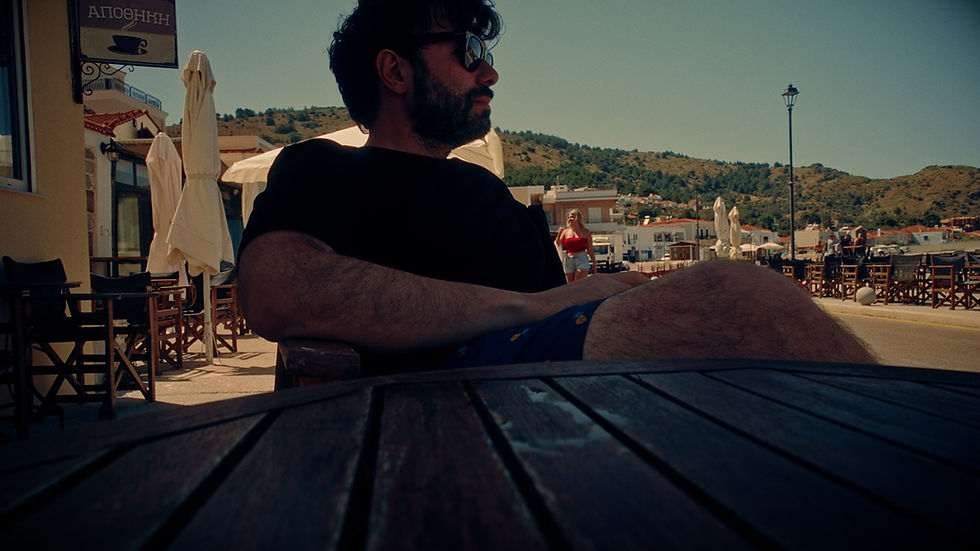
The morning after the opening, the exhibition continued without me.
I was elsewhere on the island, drinking coffee beside the sea. For once, I was not selecting the photographs, editing them, arranging them or explaining them.
They had become detached from my archive and from my screen.
A photograph begins as something a photographer takes away: a file, a choice, a memory of a particular place and moment.
If it is fortunate, it eventually becomes something that can be left behind.
I arrived in Chios carrying photographs.
I left without them—not because they had disappeared, but because they were finally somewhere else.
The island remained. The museum remained. The work remained.
And I was already beginning to think about the next problem.
Explore the work
Watch I Took This Photograph Back to a Greek Island
The exhibition Caryatis Delta | Chios opened at the Chios Mastic Museum on 15 July 2026, with public presentation from 16 July to 31 December 2026. For institutional information and visiting details, consult the official PIOP exhibition page.
Love xx


Comments