Beyond Stocks and Bonds: How Alternative Investments and Fine-Art Photography Can Diversify a Portfolio
- George Tatakis

- May 28
- 19 min read
Updated: Jun 3
Most investment articles begin with the same advice: diversify your portfolio.
It is good advice. It is also incomplete.
For most people, diversification means holding a sensible mix of stocks, bonds, cash, perhaps real estate, and maybe some gold or commodities. That remains the foundation. A serious portfolio should not be built around fashionable objects, emotional purchases, or the hope that a single rare item will one day rescue your retirement plan.
But once that foundation exists, a more interesting question appears: what belongs at the edge of a portfolio?
This is where alternative investments enter the conversation. Real estate, commodities, private equity, infrastructure, gold, collectables, fine art and other tangible assets are often discussed as ways to diversify beyond public markets. Some are financial products. Some are physical objects. Some produce income. Others do not. Some are liquid. Others may take months or years to sell well.
Fine-art photography belongs in this conversation carefully, not aggressively.
It should not be presented as a replacement for the S&P 500, bonds, real estate, gold, cash or index funds. It does not pay dividends. It does not produce rent. It cannot usually be sold instantly at a transparent market price. It is not suitable for someone who has not already built a stable financial base.
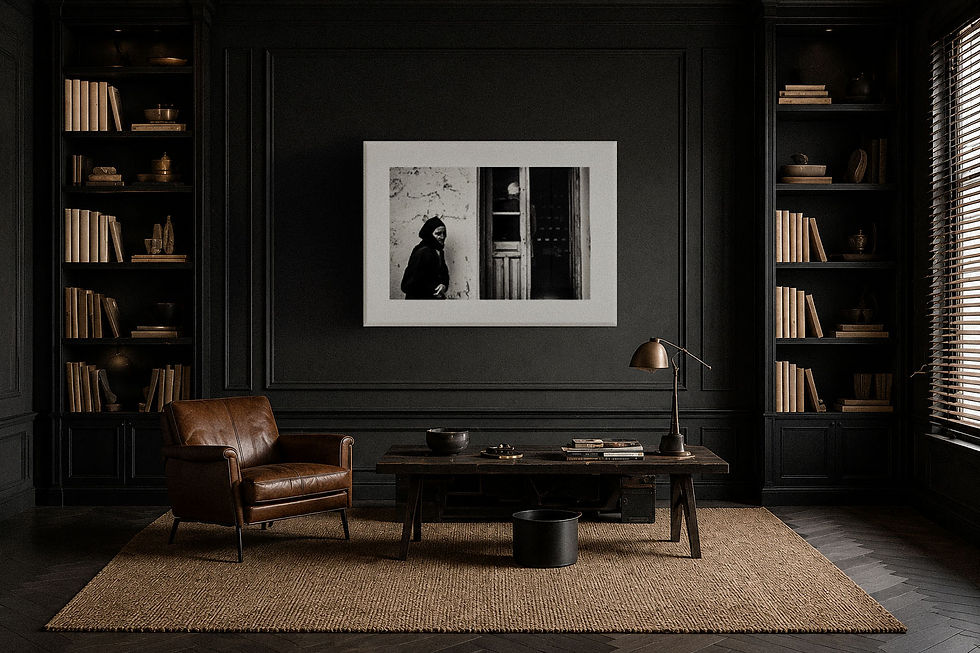
But for a financially secure collector, a museum-grade photograph can be something different from a normal investment. It can be a tangible asset, a cultural object, an interior presence, a record of identity, and a possible long-term store of value. It can also be enjoyed every day while it is held.
That last point matters.
An index fund may compound quietly in an account. A bond may pay interest. A property may provide shelter or rent. A fine-art photograph lives with you. It changes a room. It carries an artist’s authorship. It becomes part of the atmosphere of a home, office, hotel, collection, or family legacy.
This article is not financial advice. It is an educational guide to help you understand where fine-art photography may sit inside the wider language of portfolio diversification, alternative assets and collectables.
What Does It Mean to Diversify an Investment Portfolio?

Diversification means spreading capital across different assets so that the portfolio does not depend on a single source of return.
A basic diversified portfolio usually includes several asset categories. Stocks may provide long-term growth. Bonds may offer income and stability. Cash gives liquidity. Real estate may provide exposure to property values and, in some cases, rent. Gold and commodities may behave differently from financial assets in certain economic environments.
The important word is not variety. It is behaviour.
Owning ten different technology stocks is not the same as diversification if all ten respond to the same market forces. A stronger portfolio holds assets that do not always move together. Financial professionals call this correlation.
If one part of a portfolio falls, another may remain stable or rise. That does not eliminate risk. It does not guarantee profit. It simply reduces the danger of depending entirely on one asset, one sector, one country, one currency, or one idea.
The traditional version of this idea is the stock-and-bond portfolio. A younger investor may hold more equities. A conservative investor may hold more bonds and cash. A property owner already has exposure to real estate. A business owner may already have concentrated risk in their own company.
There is no universal allocation. Time horizon, income, liquidity needs, debt, tax position, risk tolerance and family obligations all matter.
This is why art should not be the starting point.
It comes much later.
The Foundation: Stocks, Bonds, Real Estate, Gold and Cash
Before considering art, photography, watches, wine, classic cars or other passion assets, it helps to understand the role of the main asset classes.
Equities, such as broad stock-market index funds, have historically been the engine of long-term growth. They are volatile, but they are liquid, transparent and widely researched. The S&P 500 is often used as a reference point for U.S. large-cap equities, and many investor-education sources cite roughly 10% as a long-term historical average annual return before inflation. That figure is not a promise. It is a historical observation.
Bonds usually play a different role. They may provide income and reduce volatility, although bonds are not risk-free. Interest-rate changes, inflation and credit risk can affect bond prices. Still, for many portfolios, bonds act as ballast.
Cash is not a growth asset, but it is essential. It covers emergencies, near-term obligations and opportunities. A portfolio with no cash may look efficient on paper and feel terrifying in real life.
Real estate is both an investment and, for many people, a place to live. It can offer inflation protection and the benefit of leverage, but it also comes with transaction costs, maintenance, taxes, insurance, local-market risk and limited liquidity.
Gold is a tangible asset with a long history as a store of value. It produces no income, but it is liquid, globally recognised and often discussed as a hedge against currency debasement or financial stress.
These assets are not interchangeable. Stocks are not gold. Real estate is not cash. Bonds are not art. Each has a different function.
Fine art, including fine-art photography, should be evaluated in this same way. Not by asking, “Will it beat the stock market?” but by asking, “What role could this object realistically play?”
Where Alternative Investments Fit

Alternative investments are generally assets outside traditional stocks, bonds and cash. Depending on the context, this can include private equity, hedge funds, private credit, infrastructure, commodities, real estate, farmland, timber, collectables, and fine art.
The appeal is simple. Alternative assets may behave differently from public markets. They may provide exposure to different economic drivers. They may help reduce reliance on listed equities and bonds.
The reality is more complicated.
Alternatives often come with higher fees, less transparency, longer holding periods, limited liquidity and greater difficulty in valuation. A listed stock has a visible market price. A limited-edition photograph does not. A public bond may have daily pricing. A painting may depend on the taste of a small group of collectors, galleries, advisors and auction buyers.
That does not make art irrelevant. It simply means art is not a normal financial product.
For many investors, alternative assets should be a satellite allocation rather than the core. They belong after the basics are secure: emergency cash, sensible debt management, retirement planning, insurance, broad market exposure and a realistic understanding of risk.
A useful mental model is this:

Collectables and Passion Assets: Investment, Enjoyment, or Both?
Collectables occupy a strange place in wealth.
They are physical objects, but their value is not only physical. A rare watch is not valuable because it tells time more accurately than a phone. A classic car is not valuable because it is efficient transport. A painting is not valuable because canvas and pigment are expensive.
Collectors value rarity, authorship, history, condition, provenance, taste, cultural meaning and desire.

This is why collectables are often called passion assets. People buy them partly because they may hold or increase value, but also because they want to live with them, study them, talk about them, display them, and eventually pass them on.
UBS has reported that many wealthy collectors consider their collections meaningful parts of their wealth, yet many are driven by passion more than profit and may not treat their collections with the same discipline as financial assets.
This emotional component can be a strength and a weakness.
It is a strength because the owner receives a return that cannot be measured on a spreadsheet: daily enjoyment, cultural identity, a richer interior environment, connection to an artist, and perhaps the satisfaction of preserving something meaningful.
It is a weakness because emotion can lead to overpaying, neglecting insurance, ignoring condition, failing to keep documentation, or believing that personal attachment automatically creates market value.
It does not.
The market does not care how much you love an object unless someone else is willing to pay for it.
Is Art a Good Investment?
The honest answer is: sometimes, for some works, for some collectors, over long periods, and usually with more uncertainty than people expect.
Art has produced spectacular public stories. A painting bought decades ago sells for millions. An artist’s market rises after museum recognition. A collector buys early and is rewarded later. These stories are real.
They are also incomplete.
The art market is not one market. It is thousands of markets. Old Masters, contemporary painting, sculpture, photography, prints, regional art, emerging artists, and blue-chip auction works all behave differently.
Academic research has also challenged the way art-market returns are often presented. Studies using repeat-sales data have found that reported art returns can be overstated because the works that return to auction are not necessarily representative of all works. Successful works are more likely to resell. Weak works often disappear into private collections and do not appear in the data.
This is crucial.
If an index tracks the artworks that successfully resell, it may miss the many works that never resell well. That creates selection bias. In plain English: the winners are easier to see than the losers.
So, art can be an asset. But it should not be treated like a broad index fund.
A single artwork is closer to owning a single private company than owning the whole market. The outcome depends on the artist, the work, the price paid, the condition, the documentation, the future market, and the ability to find a buyer when the time comes.
Art Compared with Stocks, Real Estate, Gold and Bonds
The wrong question is: “Is art better than stocks?”
The better question is: “What does art do that stocks do not?”
Stocks offer liquidity, transparency, income in some cases, and historically strong long-term returns. Bonds offer income and structure. Real estate can offer shelter, rental income and leverage. Gold offers liquidity and a recognised store-of-value function. Cash offers immediate flexibility.
Art offers something else: physical presence, cultural meaning, scarcity, authorship, and emotional return.
That difference matters because it changes the way art should be judged.

This comparison shows why art should not be forced into the same box as stocks. It does not win by behaving like a stock. It belongs, when it belongs at all, in the part of a portfolio where financial logic meets cultural value.
For a collector, the question becomes more personal:
Would I be comfortable owning this even if it never appreciates?
Would I still want it on my wall ten years from now?
Is the work properly documented?
Is the artist’s practice serious and coherent?
Can I afford to hold it without needing to sell quickly?
If the answer to these questions is no, the purchase should probably not be made under the word “investment”.
Fine-Art Photography as a Tangible Alternative Asset
Fine-art photography is one of the more interesting niches within art collecting because it sits between image, object and edition.
A photograph is not only what it depicts. It is the author’s selection, composition, timing, printing, scale, paper, edition structure and context within a larger body of work.

A decorative print can be beautiful. A collector-level fine-art photograph must usually offer more. It should have authorship, technical quality, controlled production, clear documentation, and a defined relationship to the artist’s wider practice.
This is where photography differs from mass reproduction.
A poster may decorate a room. An open-edition print may offer accessible ownership of an image. A signed print adds a direct connection with the artist. A numbered limited edition introduces scarcity and collector clarity.
None of these categories is automatically superior for every buyer. They serve different purposes.
An open edition can be a wonderful way to live with an artist’s work at a more accessible price. A signed open edition may suit a collector who values the artist’s hand and authorship but does not need strict scarcity. A limited edition is usually the more serious collector's object because the number of prints is controlled and documented.
For investment-minded collectors, this distinction matters.
Scarcity does not guarantee appreciation. But without scarcity, documentation and provenance, a photograph is harder to understand as a collectable asset.
What Makes a Fine-Art Photograph Collectable?
A fine-art photograph becomes collectable through a combination of factors. No single one is enough.
Authorship
The collector is not simply buying a subject. They are buying an artist’s way of seeing.
A photograph of a landscape, a person, a village, or a ritual becomes meaningful when it carries a distinct visual language. In serious collecting, the artist’s wider body of work matters. A strong image is strengthened when it belongs to a coherent project.
Edition structure
Edition size defines scarcity. A photograph printed in an edition of four is a different collecting proposition from a photograph printed in an edition of fifty, and both are different from an open edition.
The edition should be clear. How many prints exist? Are there artist’s proofs? Does the edition apply to one size or all sizes? Is the print numbered? Is it signed? Is there a certificate?

Production quality
A fine-art photograph is a physical object. Paper, ink, print method, tonal range, mounting, framing and glazing all influence how the work lives over time.
Museum-grade production is not a marketing phrase. It refers to materials and processes intended for longevity, stability and presentation quality.
Provenance and documentation
Provenance is the history of ownership. Documentation may include invoices, certificates of authenticity, gallery records, edition records and exhibition history.
For a collector, these are not minor details. They are part of the object’s identity.
Condition
Photography is sensitive to handling, humidity, sunlight, poor framing and physical damage. A print in poor condition may lose both visual and market value. Good framing and proper care are part of responsible ownership.
Cultural significance
Some photographs matter because of what they preserve. A portrait, a ritual, a place or a tradition may become more important as the world around it changes.
This does not automatically create market value. But it can deepen the work’s cultural and emotional value, especially when the project is coherent, researched and recognised.
Why Black-and-White Fine-Art Photography Appeals to Collectors
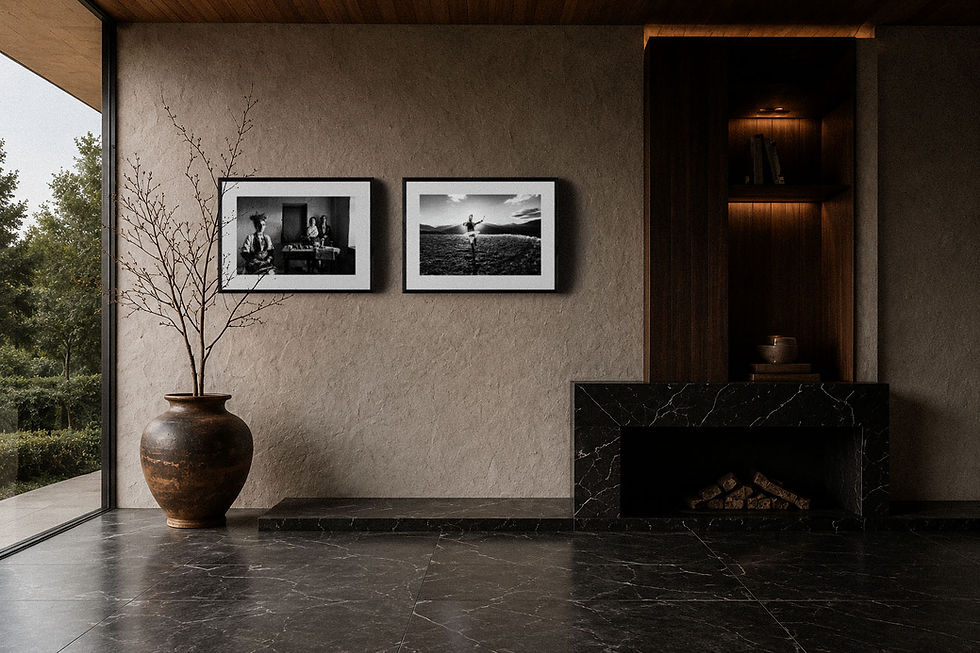
Black-and-white photography has a particular authority in the history of the medium.
It removes the distraction of colour and forces attention onto form, light, gesture, composition and structure. In a collector’s interior, black-and-white work often has another advantage: it can sit with architecture, furniture, stone, wood, concrete, books and textiles without fighting the room.
But the best black-and-white photography is not neutral decoration. It has a point of view.
For my own work, black and white is not a nostalgic filter. It is the way I organise the image. I am interested in geometry, rhythm, contrast, silence and the relationship between people and cultural memory.
A collector who buys black-and-white photography is often responding to that tension: the work is physically quiet, but visually decisive. It can feel restrained in a room while still carrying real weight.
This is especially true when the subject is culturally rooted.
Caryatis and Ethos: Cultural Photography as Collector Work

My projects Caryatis and Ethos are rooted in Greek culture, identity and tradition.
Ethos began as a body of black-and-white photographs made during local cultural events throughout Greece. Many of these rituals can seem strange when seen without context. That strangeness is important. It reveals how much of cultural life exists outside the polished surface of modernity.
Caryatis developed from that foundation into a more directed project: staged portraits of women wearing traditional local Greek clothing. These photographs are not costume records in the narrow sense. They are portraits of cultural memory, form and presence.
The work has received 24 international awards and has been published and exhibited internationally. But awards are not the reason to collect them. They are simply external signals that the work has entered a wider conversation.
For a collector, the deeper question is whether the work carries something that will remain significant.
Greek traditional clothing is not merely fabric. It contains regional identity, social codes, craft, ceremony, gender, memory and local history. When photographed with care, it becomes more than ethnographic material. It becomes form. It becomes presence. It becomes a way of looking at continuity.
This is why culturally rooted fine-art photography can belong in a collector’s environment. It is not only an image on a wall. It is a position.
The Difference Between Decorative Art and Collectable Art
There is nothing wrong with decorative art.
Most people first buy art because they want a room to feel better. That is a valid reason. A home without images can feel unfinished. A hotel without art can feel anonymous. An office without visual identity can feel temporary.
But decorative art and collectable art are not the same thing.
Decorative art is usually chosen because it fits a space. It may be beautiful, harmonious, affordable and emotionally pleasant. It does not necessarily need strict documentation or scarcity.
Collectable art must hold up beyond the room. It should still be interesting without the sofa, without the wall colour, without the interior designer’s mood board.
A collectable photograph should be able to answer questions:
Who made it?
When was it made?
What project does it belong to?
How many prints exist?
What materials were used?
Is it signed?
Is it numbered?
Is it documented?
Has the artist’s work been published, exhibited or collected?
This does not mean every collector must buy only limited editions. An open edition can be the right choice for someone who wants the image rather than the scarcity. But if the buyer is thinking in terms of collecting, legacy or possible future value, the structure matters.
Risks of Treating Art Like a Normal Financial Product
This is the part many art-investment articles avoid.
Art is illiquid. Selling well takes time. Auction houses, galleries and advisors may charge significant fees. A buyer may not appear when you want one. A photograph that feels important to you may not have a strong secondary market.
Art pricing is opaque. Unlike public equities, there is no single daily market price for a specific photograph. Gallery prices, auction results, private sales and artist-direct prices may not be directly comparable.
Art has condition risk. A print can be damaged by light, humidity, poor framing, careless handling or accidents.
Art has authenticity and documentation risk. Missing certificates, unclear edition structures or weak provenance can make resale harder.
Art has artist-specific risk. The market may rise or fall depending on an artist’s career, reputation, representation, exhibitions, publications and collector demand.
Art has no yield. It does not pay rent, interest or dividends.
Art has taste risk. Cultural preferences change.

These risks do not make collecting irrational. They make honesty necessary.
A sensible collector should buy art with money they can afford to hold in an illiquid object for a long time. The primary return should be the experience of owning the work. Any financial appreciation should be treated as possible, not promised.
How to Think About Art Allocation Responsibly
There is no correct percentage of a portfolio that should be held in art.
For many people, the answer is zero. That is perfectly rational.
For others, especially people who already have diversified financial assets, art may belong in a small passion-asset allocation. This allocation should not interfere with emergency liquidity, retirement needs, business obligations, debt repayment, education planning or family security.
A responsible approach might look like this:
First, secure the core portfolio.
Second, define the role of alternative assets.
Third, decide how much of that alternative bucket, if any, can be allocated to collectables or fine art.
Fourth, buy only work that you would be willing to live with even if it never appreciates.
Fifth, keep documentation.
Sixth, insure and care for valuable works.
Seventh, make sure heirs know what the work is, where documentation is kept, and whether the work has resale, donation or family value.
This is not romantic. It is practical.
The more emotional the asset, the more disciplined the paperwork should be.
Buying Fine-Art Photography: A Collector’s Checklist

Before acquiring a fine-art photograph, ask these questions.
Who is the artist, and what is their wider body of work?
Is the photograph part of a coherent series or an isolated image?
Is the print open edition, signed open edition, or numbered limited edition?
What is the edition size?
Are artist’s proofs included?
What is the exact print size and framed size?
What paper and printing method are used?
Is the work signed?
Is there a certificate of authenticity?
Is provenance recorded?
What condition is the work in?
How should it be framed, stored, shipped and insured?
Does the price make sense relative to the artist’s career, edition size, scale, production quality and available works?
Most importantly: would you still want to own this if no one ever told you it was a good investment?
Why Buying Directly from the Artist Can Matter
There are several ways to buy art: galleries, art fairs, auctions, online platforms, advisors and directly from artists.
Each has advantages.
Galleries can provide curation, context, relationships and secondary-market knowledge. Auctions can reveal public demand, though they also create pressure and fees. Advisors can help build collections. Online platforms increase access.
Buying directly from an artist offers something different: clarity of source.
When you buy directly from the artist or their studio, documentation can be straightforward. Edition records are clear. The relationship is closer. You understand the work through the person who made it.
This does not remove all risk. It does not guarantee future value. But it can strengthen provenance from the beginning.
For collectors interested in my work, the most serious works are numbered limited editions, produced as museum-grade pigment prints, signed, documented and prepared for long-term presentation. Open editions and signed prints offer more accessible ways to own the work, while limited editions serve collectors who value scarcity and formal documentation.
Fine-Art Photography in Homes, Hotels and Professional Spaces
A fine-art photograph does not need to be locked away in storage to be serious.
One of the advantages of photography is that it can live naturally in interiors. A large black-and-white print can give a room visual structure without overwhelming it. It can work in a private home, a law office, a hotel suite, a restaurant, a boardroom or a quiet corridor.

This is another way fine-art photography differs from purely financial assets. It has utility while held. Not financial utility, but spatial and emotional utility.
It improves the life around it.
For hotels and professional spaces, culturally rooted photography can also create identity. A Greek hotel does not need generic wall art. A law office does not need anonymous decoration. A restaurant does not need another print that could be anywhere.
Art can make a space specific.
So, Is Fine-Art Photography a Good Alternative Investment?
It can be, but only under a careful definition of “good”.
If “good” means liquid, predictable, income-producing and easy to price, then no. Fine-art photography does not behave like a stock index, bond fund or bank account.
If “good” means a small, tangible, culturally meaningful asset that may hold or increase value over time while also providing daily enjoyment, then fine-art photography can belong in the alternative-assets conversation.
The key is proportion.
Fine-art photography should be a complement, not a foundation. A collector should buy with knowledge, documentation and patience. The work should be strong enough to justify ownership even without a resale story.
That is the safest way to approach art.
Not as a promise.
As a serious object.
Final Thought: The Return You Can Live With
A diversified portfolio is built to survive uncertainty. It should not depend on one stock, one property, one currency, one country, one asset class or one beautiful object.
Fine-art photography belongs only after that is understood.
A museum-grade photograph may appreciate. It may become part of a serious collection. It may carry cultural value into another generation. But before any of that, it should do something simpler and more important.
It should be worth living with.
For collectors drawn to black-and-white photography, Greek culture, traditional dress, ritual, landscape and identity, the Caryatis and Ethos works offer a way to collect not only an image, but a fragment of cultural memory made physical.

For collectors, hotels or professional spaces seeking guidance, request a private selection of available works.
Frequently Asked Questions
What is portfolio diversification?
Portfolio diversification is the practice of spreading investments across different assets, sectors, countries and risk profiles so the portfolio does not depend on one source of return. A diversified portfolio may include stocks, bonds, cash, real estate, commodities and, for some investors, alternative assets.
What are alternative investments?
Alternative investments are assets outside traditional stocks, bonds and cash. They may include real estate, private equity, hedge funds, commodities, infrastructure, collectables, and fine art. They can offer diversification, but they often come with lower liquidity, higher complexity and less transparent pricing.
Are collectables a good investment?
Collectables can be valuable, but they are not simple investments. Their value depends on rarity, condition, provenance, demand and fashion. They are usually illiquid and may require storage, insurance, authentication and expert knowledge. They are best approached as passion assets first and financial assets second.
Is art a good alternative investment?
Art may provide diversification, cultural value and possible long-term appreciation, but it also has serious risks: illiquidity, subjective pricing, authenticity issues, condition risk, high transaction costs and no income. Academic research suggests art-market returns are often more modest and riskier than promotional art-investment claims imply.
Is fine-art photography a good investment?
Fine-art photography can be a meaningful collector asset when the work has strong authorship, limited edition structure, museum-grade production, documentation, provenance and cultural significance. But it should not be bought with guaranteed financial returns in mind. The first return should be the experience of owning the work.
Do limited-edition prints increase in value?
They can, but there is no guarantee. Limited editions create scarcity, which can support collector interest, especially when the artist’s reputation grows. But appreciation depends on many factors: demand, edition size, condition, provenance, the artist’s career, and the broader market.
What is the difference between open edition and limited edition prints?
An open edition can be produced without a fixed maximum number of prints. A limited edition has a defined number of prints, often signed and numbered, and usually accompanied by documentation. Open editions are more accessible; limited editions are generally more relevant to collectors who value scarcity.
How much of a portfolio should be in art?
There is no universal answer. For many investors, the correct allocation is zero. For financially secure collectors, art may form part of a small alternative or passion-asset allocation. It should never compromise liquidity, retirement security, emergency reserves or core investment goals.
What should I check before buying a fine-art photograph?
Check the artist’s body of work, edition size, print size, materials, signature, certificate of authenticity, provenance, condition, framing, shipping and insurance. Also, ask whether the image still holds your attention after repeated viewing. A serious acquisition should not depend only on first impression.
Should I buy art directly from an artist?
Buying directly from an artist can offer clear provenance, direct documentation and a closer connection to the work. Galleries and advisors also have value, especially for secondary-market knowledge. The best channel depends on the collector’s goals, budget and confidence.
Disclaimer: This article is for educational and informational purposes only. It is not financial, legal, tax or investment advice. Fine art and collectables are illiquid and may lose value. Always consult qualified financial, legal and tax professionals before making investment decisions.


Comments